
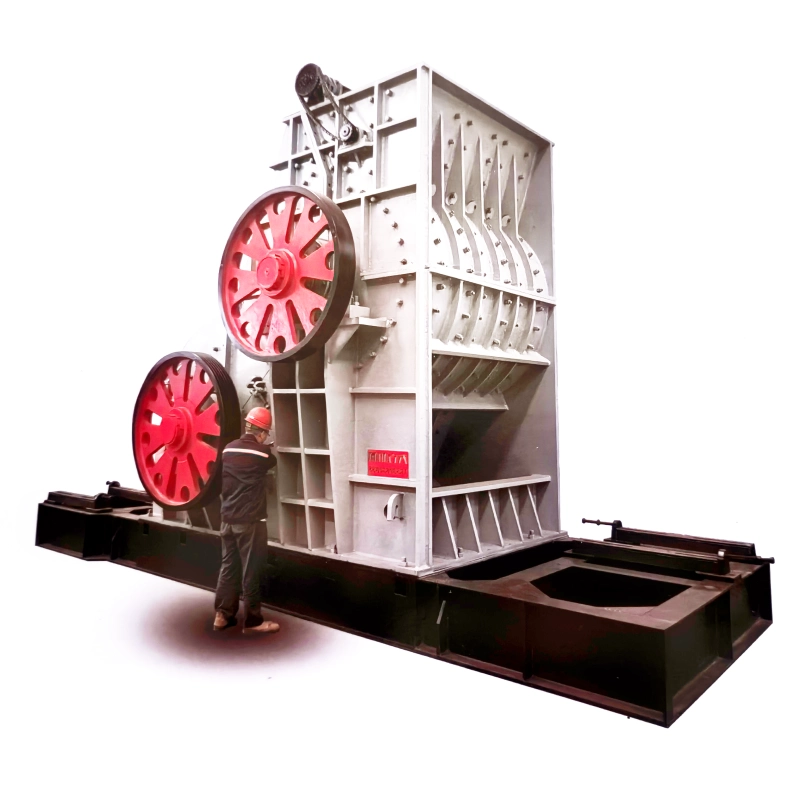
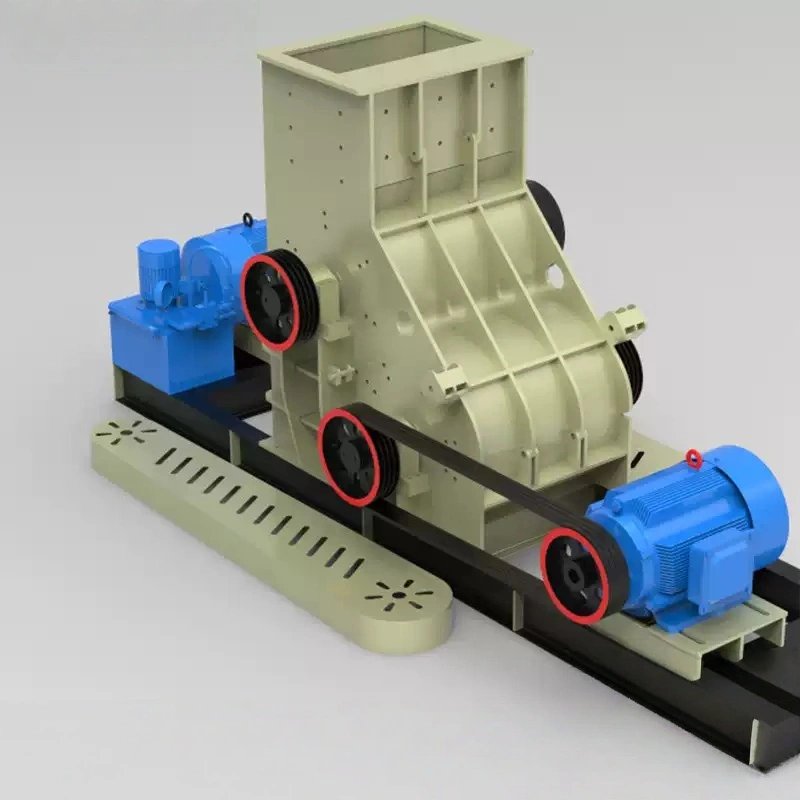
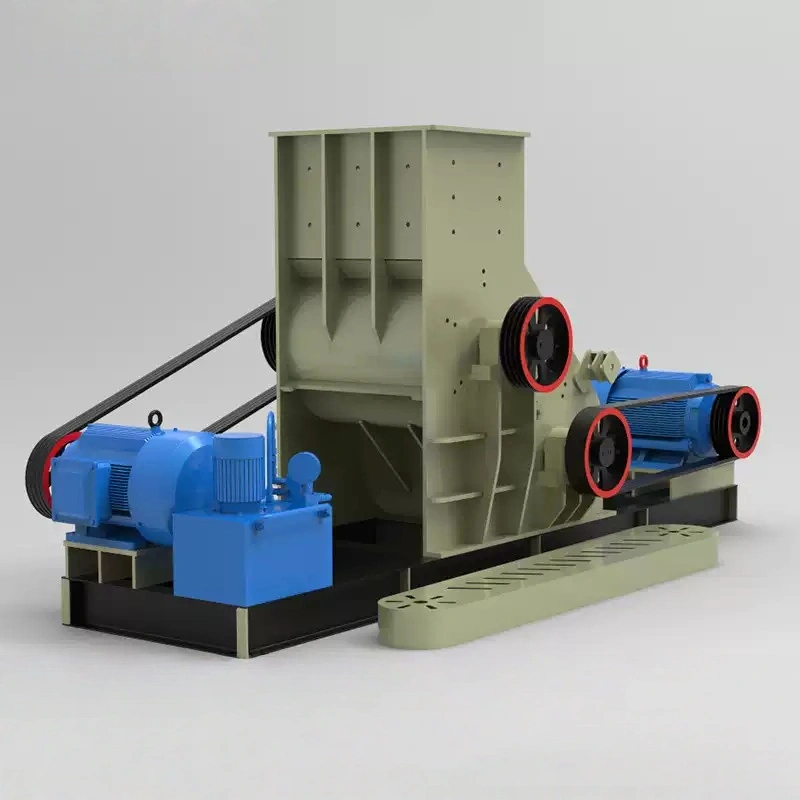

SF series non-clogging hammer mill is an innovative product designed for crushing process with wet, sticky materials like clay, bauxite, bentonite, shale, gangue, etc.
Different from traditional hammer mill, non-clogging hammer mill is two stage crushing and screenless. This unique design gives it ability to reduce materials to suitable size without clogging, at the same time, to produce fine output at high capacity.

Non-clogging hammer mill actually integrates two crushing processes into one unit. When materials are fed into upper chamber, hammers in staggered arrangement flying at a high speed will crush them into smaller size. And hammers in lower chamber will impact them into fine particles further in secondary crushing. Material lumps are not only crushed by hammers, but also impact with each other, and finally get discharged directly with particle size less than 3mm.
Traditional crushers with screen or grate bars are easily clogged when processing wet materials. If to solve the problem by increasing screen hole size or grate bar distance, that will increase recirculating load of crusher and reduce proportion of fine particles. Bricks made from such raw material will have rough surface, muddy sound and low strength.
Non-clogging hammer mill can guarantee not only smooth production, but also reasonable particle size distribution. Among 3mm fine output, 90% is powders less than 2mm, 50% is powders less than 0.5mm. Such materials are really good for the production of perforated bricks, hollow bricks, fired block.
Paste fill is an engineered backfill method in underground mining that uses a mixture of filtered tailings, water, and binding agents (like cement) to fill empty, mined-out voids. Non-clogging hammer mill can crush coal gangue into fine particles for preparation of paste, and require no addition of fine materials like fly ash. This method can reduce storage space and environment pollution caused by coal gangue stockpiling.
Let’s take iron ore as an example. Non-clogging hammer mill can free valuable minerals from surrounding wastes by fine crushing process. After primary beneficiation, low grade ore (3~5%) can be enriched to 20~40%. 70% of undesired waste is discarded. This can greatly reduce material feed into ball mill. Ball mill capacity can be increased by 50%. This scientific mineral processing philosophy “more crushing, less milling” , “obtain desired & discard undesired at early stage” can help to create more economical benefits.
Also, non-clogging hammer mill is widely used in cement plant, power plant, coal washing plant, coking plant, etc.
| Model | Input size (mm) | Output size (mm) | Capacity (t/h) | Allowed moisture | Power (kW) |
|---|---|---|---|---|---|
| ZD2200×2000 | ≤200 | ≤3 | 330~280 | ≤20% | 500+500 |
| ZD2000×1600 | ≤200 | ≤3 | 200~280 | ≤20% | 355+355 |
| ZD1600×1400 | ≤180 | ≤3 | 120~180 | ≤20% | 220+250 |
| ZD1400×1200 | ≤150 | ≤3 | 90~120 | ≤20% | 132+160 |
| ZD1200×1000 | ≤130 | ≤3 | 60~90 | ≤20% | 110+132 |
| ZD1100×1000 | ≤130 | ≤3 | 50~80 | ≤20% | 90+110 |
| ZD900×800 | ≤100 | ≤3 | 40~60 | ≤20% | 55+75 |
| ZD800×700 | ≤100 | ≤3 | 30~40 | ≤20% | 55+55 |
| ZD600×600 | ≤100 | ≤3 | 20~30 | ≤20% | 22+22 |
| ZD600×400 | ≤100 | ≤3 | 15~25 | ≤20% | 18.5+22 |
